When would you want to throw a medicine ball versus quickly chop and hold onto the ball? (Chop shown below on the left, and a throw shown below on the right.)
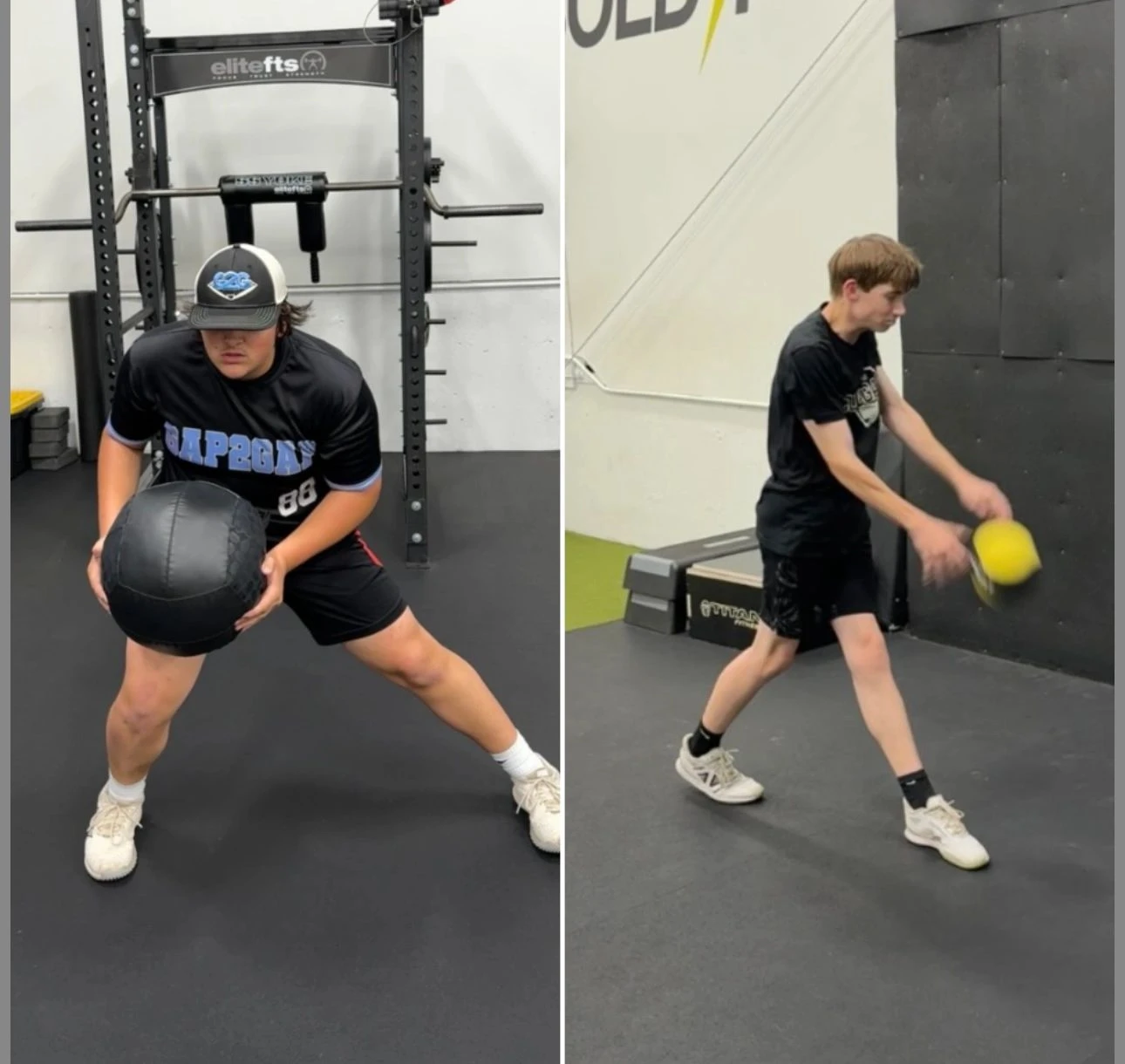
When holding on to the med ball during the chop, the body is going to move with the ball during the fast downward phase, and then the ball is rapidly stopped above the leg and held for three seconds.
Watch the original training video (opens in a new tab)
According to Newton's first law: an object will not change its direction unless a force is acted upon it. So we are utilizing the momentum of the ball to teach us to rapidly absorb force in the bottom position.
Watch the original training video (opens in a new tab)
The chop inside of the base of support could be represented by the body lowering into a cutting position while changing directions at high speeds. Getting into this position requires us to stop our momentum by absorbing force just like with the med ball chop shown.
Watch the original training video (opens in a new tab)
Chopping inside of the base of support will allow for more access to relative movements, (concept coined by Bill Hartman).
Relative movements are when we move a bone on one side of a joint relative to the bone on the other side of the same joint.
In a baseball swing we want to first turn away from the pitcher to create more potential energy into the forwards turn towards the pitcher during the swing.
Amid the initial counter movement turn in the baseball swing, here's what happens at the pelvis with access to relative movements...
Rear side: sacrum moving backwards relative to the ilium to attain a position of external rotation.
Simultaneously...
Front side: ilium moves forwards relative to the sacrum, creating a turn towards the rear side.
Without relative movements the whole pelvis would turn, and we might see undesired movement. Examples being a knee caving in, or part of the foot losing ground contact.
Relative movements can help us move faster with more location consistency, and with less potential injury risk. Relative movements are measured with specific testing during evaluations.
Watch the original training video (opens in a new tab)
Shown above, the connective tissues absorbing force on the right leg while the muscles remain stiff.
Connective tissues are everything besides bone, muscle, and organs. Connective tissues can change shape or lengthen at higher speeds than muscles can. In high velocity movement, the connective tissues change shape & store and release energy while the muscle remains stiff. Hence, bodybuilders not being able to throw faster than a skinny MLB baseball pitcher.
Watch the original training video (opens in a new tab)
According to Newton’s third law, for every action there is an equal and opposite reaction.
Based on this principle, when the ball is released during a throw, the ball is applying the same amount of force into the thrower, as the thrower is applying into the ball.
Since the thrower is bigger than the ball, the ball will move further than the thrower in the opposite direction. During ball release the thrower must use a strategy to resist moving away from the ball. Therefore, medicine ball throws are going utilize a stiffer connective tissue representation medicine ball chops.
Watch the original training video (opens in a new tab)
Medicine ball chops bias force absorption, and medicine ball throws bias force production. It's important to understand which is a better option for you based on how you currently move. Get an evaluation done, and have an experienced coach watch your movements consistently. If you are a coach or athlete, and you have any questions about applying these principles feel free to reach out to me, drewcobin@boldtperformance.com via email.